Showing posts with label Classic Movies. Show all posts

Sunday, September 6, 2015

10 Great Screenplays: #2 Chinatown (1974)

As I'm nearing the end of this countdown, I find it more and more difficult to steer away from the Writers' Guild picks for best written screenplays of all-time. While I disagreed with many of the earlier choices, the ones at the top are very difficult to find replacements for. Their quality simply happens to be a little better than the competition. Aside from that, they are great examples as to what a screenplay should possess.

Without further ado, here is the penultimate screenplay on my personal list: Robert Towne's Chinatown. The finished product, directed by the troublesome Roman Polanski and starring Jack Nicholson, is considered by many to be a classic. It could even be called the quintessential neo-noire, which is far from uplifting but full of mystery, romance, double-dealing, and fate playing it's dirty tricks on the characters involved.
Image result for chinatown 1974
What's going on out here?
One massive reason for the film's revered status is the wonderfully wrought screenplay by Mr. Robert Towne. It is everything a screenwriter wishes they could write, thematically and characteristically powerful. 

The story opens in the office of private eye Jake Gittes, a private detective. He's good at what he does, as the opening reveal of a wife's affair shows, and cares a lot about his intentionally pristine image. A woman enters, wanting to know if her husband is having an affair, and he eventually takes the job when the man involved is a high-profile city engineer (Hollis Mulwray) who heads the water department. The job appears an elementary one and he snaps pictures of Mulwray with a young woman. Then, when the story hits the newspapers, the real Mrs. Mulwray appears and serves Gittes with a subpoena. 

He's angry. Who would want to mislead him like that? He now takes it into his own hands to figure it out. Shortly thereafter, Mulwray is murdered and Mrs. Mulwray is the prime suspect. At this point, Gittes attempts to interrogate her and comes out of the situation knowing less than before and with a retainer from Mrs. Mulwray.
Gittes, Mrs. Mulwray, and the cops.
However, a late-night tracking mission leads him back to the water department. Someone is dumping water outside of the proper channels or so he thinks. Mulvihill, the water department security chief, tells him to mind his own business. Gittes refuses and during another personal tracking assignment, where he is nearly drowned, a henchman slits his nose.

Re-enter Mrs. Mulwray, blindingly beautiful, and the further complication of romance. Also, there's the introduction of Noah Cross, Mrs. Mulwray's father. He wants to see his daughter...his other daughter and the key to finding her is apparently Mrs. Mulwray. Gittes then discovers a land plot. Everything in the "Northwest Valley" is being bought up under false names. 

He now knows Mulwray's murder has something to do with the deal and the key to whoever set him up in the beginning lies with discovering who is behind it.

That looks like my cue to step back and examine the writing. 

First off, there's the motif of Chinatown. Gittes mentions it once or twice and it comes back with a bang in the finish. He didn't know what was going on in Chinatown when he was a cop and he definitely doesn't know what is going on throughout the course of the story. This hurts him and the people he cares about. In other words, this motif accentuates the character of Jake Gittes, around whom the story revolves. He wants everyone to think he's in control, that he can take care of the people who are relying on him, but in truth he can't.

Then there's the theme, the water, Mr. Cross, and the unwritten law. I could go on for hundreds of words as to how Towne drops in and out of the story, but I will spare you the pain. However, I can say that it was a masterful job and makes the story work on multiple levels--thematically, plotwise, and with the characters. In the end, it was fully deserving of the Academy Award and the reverential place it holds in the world of screenwriting.
Forget it, Jake, it's Chinatown...
I will close by sharing a neat tidbit of information. Towne's story was inspired by some research he did into a historical event called the "Rape of the Owens Valley" and a man named William Mulholland. It ruined a fertile valley but it saved Los Angeles by providing it with a necessary element--water.

Monday, August 31, 2015

10 Great Screenplays: #3 Citizen Kane (1941)

What is there left to be said about Citizen Kane, Orson Welle's classic masterpiece? It's impressionistic, it's filmmaking at its artistic best, and it's cinematography and directing is simply fantastic. There's a reason it belongs at the top of virtually every "best films" list. Orson Welles had control of the project from beginning to end and the result was marvelous. However, the story of an immoral newspaper magnate seemed to many an attack on one of the most powerful men in America, especially in Hollywood, at the time of the film's release, William Randolph Hearst. As a result, Welles was black-balled and never able to surpass his debut film.
Don't you love megalomania?
Now, onto the writing. After compiling a massive amount of notes on figures like William Randolph Hurst, Welles commissioned Herman Mankiewicz to write the first draft of the screenplay under the working title American. Meanwhile, Welles worked on his own version of American. Both wanted to capture the idea of a man's life being remembered by those who knew him and the image of the man changes with each telling. Welles compared his work to Mankiewicz's, merged them, and they reworked the entire thing over and over until Welles was satisfied. 

The story centers on the recently deceased Charles Foster Kane, a newspaper magnate who at one point held the power to send himself to the White House. His last word, "Rosebud," baffles everyone. A reporter, Thompson, is sent out to uncover it's meaning and perhaps find a new angle on Kane's life that the other media sources were missing. 

He first goes to meet Kane's second wife, a singer in a lowly dive, but she is unable to give the reporter anything. Then, he requests to see the memoirs of Kane's banker and long-time legal guardian, Walter Parks Thatcher. Although they are very informative on a number of things regarding Kane's childhood, Thompson can't discover anything mentioning "Rosebud." 
It's a shame the newspapermen didn't have a window into Kane's thoughts like the audience did.
After that, Thompson interviews Bernstein, a friend of Kane's who was there when he started building his journalistic empire. More interesting information is revealed, but not the information Thompson was looking for. Also, Jedediah Leland, once Kane's best friend, can't fill him in on Rosebud. No one can.

At its essence, this is the story of a futile search for a secret. The kind of secret perhaps only one person knows, the individual, the one who takes it to the grave with him. On top of that, it's a tale of perspective. The first of its kind, typical of the visionary work Orson Welles has become identified with (see his War of the Worlds radio broadcast as further proof). This part of what makes the screenplay for Citizen Kane so special. It's focus is definitely not on plot, it's focused on character and idea. Difficult to pull off, but as you can guess, the results are absolutely splendid. 

The screenplay was the only thing connected with Citizen Kane that William Randolph Hearst couldn't stop from receiving an Oscar, though I'm sure he tried. 

Thursday, August 27, 2015

10 Great Screenplays: #4 Sunset Boulevard (1950)

It's difficult to pin Billy Wilder's 1950 classic, Sunset Boulevard, under just one genre. Much of the film plays out as very serious and in the mold of a film noir, as the main character manages to dig a whole that continually gets deeper until it traps him. Also, there are many lighter moments, where laughter is illicited. Last but certainly not least, there's the satirical elements that cannot be ignored. So what appears to a drama about a doomed man has multiple layers to it, thanks to the guidance of Billy Wilder's talent as a storyteller.
Wilder steps out from behind the camera for a picture.
Now, onto the writing. The screenplay was written by D.M Marshman, Jr., Charles Brackett, and Billy Wilder. Clearly they knew a thing or two about Hollywood, it's silent past and how the game worked in the studios. All of those elements figure into the story of Joe Gillis, a two-bit writer who can't sell any of his screenplays. He's a hard-luck loser, and that's obvious from page one. Why? Because he's dead.

Here is where the screenplay differs from the finished film. Yes, you know that Gillis is dead, but it doesn't open with his body floating face-down in a pool. He's in the morgue talking to other guys who have recently made the journey into the afterlife. Each of them explain how they got there and then it's Gillis's turn. Thus begins the tale of the screenwriter whose only talent appears to be attracting all sorts of bad fortune.
Who knew the wealthy district near UCLA was so menacing?
His stories don't sell, his agent cares more about golfing than actually finding a job for his struggling client, and his car is wanted by the repo men. After his failed attempt at a pitch (a nosy reader said the story was flat), he bumps into the repo men on Sunset Boulevard. They chase him and a tire pops forcing him to turn into the nearest driveway, which the repo men luckily do not see.

The place is abandoned looking, hasn't been truly cared for in years. Then Gillis sees two people, a wealthy old lady and her butler. They mistake him for an undertaker who's supposed to have a custom made coffin for the lady's recently deceased monkey. Eventually, he explains that he's a writer, not a very successful one, but a writer nonetheless.

At this point, Gillis recognizes the old lady as Norma Desmond, a silent movie star. She lives under the illusion that her fans have never forgiven her for "deserting them." This illusion also appears to be carried by Max, the mysterious butler. Gillis takes all of this in with the cheap sarcasm becoming of the hack writer he appears to be, especially the ridiculous script Desmond has apparently spent years working on. It's long, it's silent, and it's purely amateurish, but it's his escape route from the repo boys. He can lay low and at least pretend to work on the script while setting up shop in the Ms. Desmond's swanky yet slightly run-down mansion.

During a visit to town, Gillis runs into Betty Schaefer, the nosy reader who ruined his pitch earlier and her fiancee, his old friend, Artie Green. Schaefer wants to make the jump from reader to screenwriter and feels like working with Gillis is the way to go. He initially turns her down, but after a few run-ins, he decides to work with her. Unbeknownst to ol' Ms. Desmon, who's become very possessive of the writer, he sneaks out to write a few pages every night.

With all of the suspense building, it is my cue to leave the summary and talk about what makes the writing so special. For one thing, perhaps no two writers know how make a screenplay skip along with witty and natural dialogue than Charles Brackett and Billy Wilder. Now throw in the black comedy and the satire on Hollywood. You have the makings of something very unique. The characters are colorful, bringing life to the stark, vampiristic settings in which the story takes place.
How's that for a closing shot?
In other words, the story is simply dripping with irony, a tool that is very powerful when placed in the right hands. No wonder the screenplay for Sunset Boulevard was the easy choice for Best Original Screenplay at the 23rd Academy Awards.

Monday, August 24, 2015

10 Great Screenplays: #5 The Man Who Shot Liberty Valance (1962)

When the name of director John Ford is mentioned, very seldomly does his 1962 work of art The Man Who Shot Liberty Valance come up. It, for whatever reason, is left to wander in the roads of relative obscurity. That's not saying the film wasn't a smashing success, but it is saying that the film does not receive the proper respect and notoriety it deserves. It might be cast off as just another western movie from the Hollywood assembly line with John Wayne in the lead, an assumption containing zero foundation.
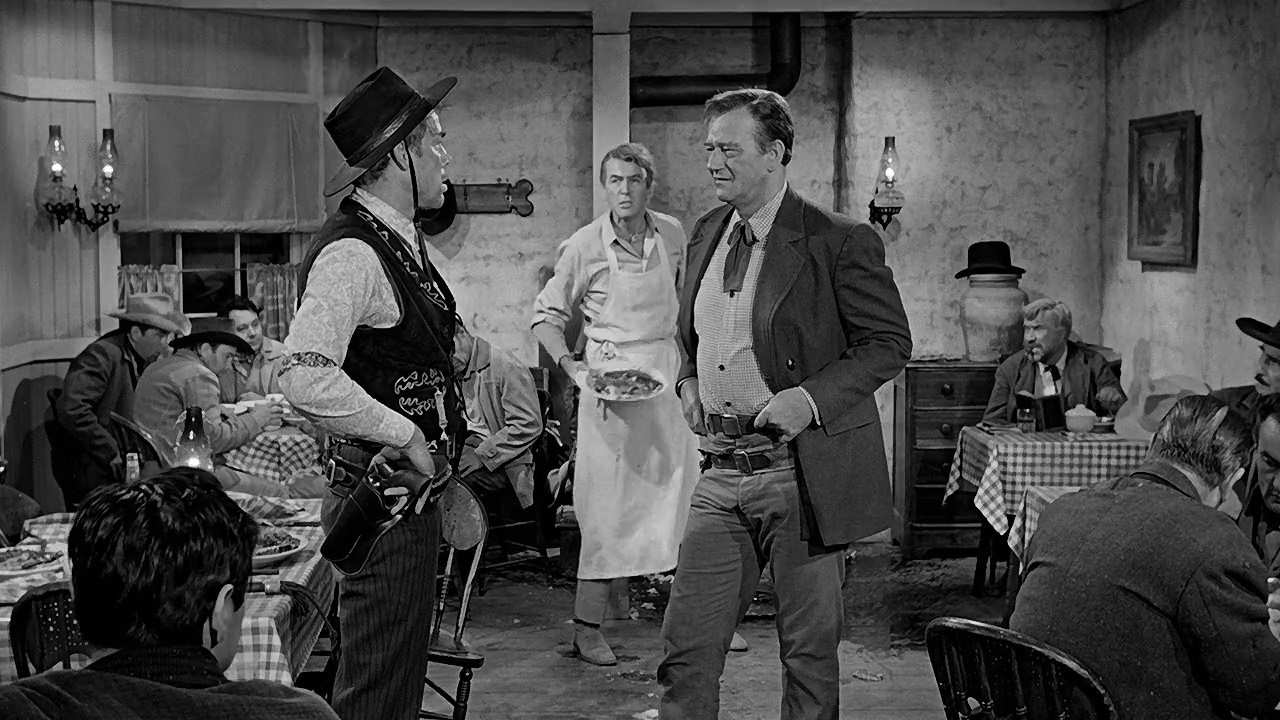
John Wayne teaching James Stewart how to take the law into his own hands.
Maybe the greatest crime of all concerning this film is the lack of credit given to the writers, James Warner Bellah and Willis Goldbeck, who adapted a short story by Dorothy Johnson into a sparkling screenplay. They grabbed all the cliches that dominate the western scene, reworked them, ironed them out, and created something very unique. Sadly, the pair received no recognition from the Academy for their work.

Anyway, onto the story. U.S Senator Ransom Stoddard and his wife, Hallie, return home to the town of Shinbone for a funeral of an old friend, Tom Doniphon. This baffles the local newspapermen, who have no knowledge of Mr. Doniphon. The editor of the Shinbone Star demands a story from Stoddard, who obliges.

In flashback, he tells the story of how he happened to come to Shinbone and his initial encounter with the ruthless and vile Liberty Valance. Stoddard is robbed and whipped severely, but Doniphon comes to the rescue, bringing him to town for treatment. Here, Stoddard meets Hallie for the first time, though he believes her to be Doniphon's girl like everyone else does. 
Left to right: Valence, Stoddard, and Doniphon.
Stoddard is given room and board at the restaurant where Hallie works in exchange for washing dishes. He also makes an effort to educate the illiterate townsfolk, including Hallie. Meanwhile, the vote for statehood is nearing and everyone knows the ranchers, who oppose statehood, have hired Liberty Valance to scare people from voting the "wrong" way. Although Stoddard received a taste of Liberty's medicine, he is determined to fight him.

At this point, Doniphon steps in and gives him a lesson about western law and order. It's being a better shot than the other guy. Stoddard hates this, but feels forced into a showdown with his enemy.

I'll leave the summary here to elaborate on the elements that make the writing so special. The Man Who Shot Liberty Valance may be the best singular showcase of the Western genre ever recorded on film. Everything about the popular genre, from law and order to changing times to the introduction of education, is on display and the result is wonderful.

Another point worth mentioning is the character of Tom Doniphon, who appears to be a supporting character, and how he is the true lead in the film. Every scene centers on him and he makes the story tick. Also, he provides a perfect analysis on the western hero. He's masculine, strong, and capable of making quick decisions, but he's not a stock or cliched character by any means. It's his sacrifice, not Stoddard's, that adds multiple layers to the story.
Who shot Liberty Valance?
Lastly, there's the famous line, "When the legend becomes fact, print the legend." This is the central theme of the story and it's holds a very singular place in the western sphere. Not only can it be applied to almost every tale in the western mythology, but also it's a new cliche. Something that the western had never quite covered before. 

Tuesday, August 18, 2015

10 Great Screenplays: #7 The Best Years of Our Lives (1946)

In some people's books, including my own, William Wyler's post-WWII masterpiece The Best Years of Our Lives may possibly be the finest film ever made. From beginning to end, the movie is simply splendid. The acting is wonderful, the direction is borderline perfect, and the writing is strictly top of the pile stuff. I could gush and awe over all of these aspects (a very special shout-out to Harold Russell, a guy who lost his hands in the war, for a beautiful performance), but, as my focus lies in the screenplay, I will stick to the writing.
Two well deserved Oscars.
Robert Sherwood, a Pulitzer Prize winning playwright, was called in to write the screenplay based on famed novelist MacKinlay Kantor's (author of Andersonville) massively long treatment that Kantor turned into a novel titled Glory for Me. He took the material and crafted one of the most unique screenplays ever written (I'll get to that in a bit). It centers around a very simple premise--three guys returning home from the war.

As you may surmise, the story is all about character. In fact, interestingly enough, there is no clear-cut antagonist in this film. Each of the soldiers are returning to an entirely changed America, one that will try to "rehabilitate" them at every opportunity.

The first man to return home is Homer Parrish, a Navy man. He lost his hands in the war and his family takes it very hard, especially his mother. His fiancee Wilma, however, is just glad her man is safely home. Still, Homer has difficulty adjusting to his new circumstances and how everyone looks upon him with pity (except Wilma). He is irritable, driving almost everyone away from him, and his confidence is shot.
The next guy to walk through his own front door is Army man, Al Stephenson, who appears to be returning home to the most pleasant conditions. His wife loves him, his children adore him, and he has immediately been promoted to Vice President and given a raise at the bank in which he works. Even so, he wants to make a difference in the lives of the numerous military men while they re-adjust to civilian life. His ideas are met with skepticism by the bank president and others who work with him, but Al maintains he will continue approving loans for servicemen where "sufficient collateral" isn't shown. 

Then there's Fred Derry, who spent the war as a bombardier in the Army Air Force. He's coming home to a wife he knew for only a short time before getting sent overseas and virtually no prospect of a good job. After some struggle in locating his wife, he finds that she has gotten a job as a night club dancer. They are reunited and they spend his severance pay very lavishly. His wife, Marie, is very materialistic and shows no understanding for his PTSD. 
A faithful wife?
On the other hand, Al's daughter, Peggy shows a great deal of patience and kindness towards Fred. Although reluctant to admit at first, she has fallen in love with the married pilot and can't shake herself out of those feelings. 

All of these elements bring about a wonderful amount of conflict and allows the audience to delve deeply into the emotions of the characters involved. Relationships are strained, new ones are formed, and struggles are very much prevalent. Two tent poles around which Hollywood has been pitched since Edison got kicked out of the business; relationships and conflict.
A wonderful showcase of deep focus cinematography.
Okay, here's where I get back to the uniqueness of Robert Sherwood's screenplay. For one thing, there is no physical antagonist. It's different for each character and it connects with the idea of rehabilitating oneself to a world that has changed and moved on. No great mercy is bestowed upon the men who fought to preserve the nation from the tyrannical Adolf Hitler and Hiro Hito. 

This is one of the central themes, and it plays into the meaning of the title, which is taken from one of Marie Derry's lines. The best years of these servicemen's lives were spent overseas fighting the war. They can't get them back and they have to do the best they can in the tough years ahead.

Wednesday, August 12, 2015

10 Great Screenplays: #10 On the Waterfront (1954)

The first film I will be showcasing as a part of my "10 Great Screenplays" series is 1954's On the Waterfront. It is probably more well-known for containing an outstanding performance from Mr. Godfather himself, Marlon Brando. In a famous scene with Rod Steiger, who plays his character's brother, Brando complains, saying he "coulda had class" (Schulberg--On the Waterfront). Don't fear, Marlon, you certainly had class in that performance as ex-boxer turned longshoreman, Terry Malloy.
Why don't you believe me? Ya got class, Brando. Don't make me fire this gun.
With the little tribute to great acting out of the way, let's get on to the important stuff--great writing. In writing On the Waterfront, Budd Schulberg pulled a wonderfully moving story out of his Hollywood brat hat and earned himself an Academy Award to boot. The dialogue is sharp and crisp, crackling off the page. Yes, I said page, because I'm addressing the screenplay, not the actual finished film.

Anyway, thanks to that, the characters' unique qualities stand out and there is absolutely no difficulty in differentiating their voices. Each of them has something important to say, at least in their eyes. "Johnny Friendly" thinks he has to stomp on everyone and everything in order to keep his corrupt organization under his heavy-handed control. He built it up from the ground and isn't about to let it go. Everyone who is affected by him, hates him, and he's completely okay with that as long as they listen to him.

One of his closest associates, Terry Malloy, a second cousin of Johnny's and an ex-boxer, is unwittingly made an accomplice to the murder of Joey Doyle, who was about to spill all he knew about the "Friendly" gang in court. His boxing days have made him a tad slow in the head, but he feels wronged and perhaps for the first time in his life, Terry's conscience is starting to nag him. Then, through various circumstances, he meets Joey's sister, Edie, who is back from college. He is immediately attracted to her and perhaps feels as though he can finally be "somebody" with her support.

The lovely Eva Marie Saint as Edie Doyle.
She is confused by Terry. She knows he is in with "Mr. Friendly," his older brother, Charley (a snappy dresser with an air of confidence) is Friendly's right hand man. As a result, Edie drives at him, hoping he will give any kind of information leading to the apprehension of her brother's killers. Also, she hopes it isn't him, that he has nothing to do with it. She's fallen in love with the rough longshoreman and wants to build a life with him. 

Of course, any character summary of On the Waterfront would be massively incomplete without Father Barry. He is a charismatic go-getter of an Irish Catholic priest. At first, he tries to help in the traditional means, offering his church as a safe haven to the longshoreman afflicted by the "Friendly" disease. That's when Edie lashes out at him with some harsh words and when his church is attacked by the bad guys. He sees the light. He'll do whatever it takes, even do things not normally characteristic of priests, to nail the oppressors of the waterfront. It is his heavenly duty.

All of these elements beautifully come in conflict throughout the story and make for one powerfully written film. 

Interestingly enough, Budd Schulberg based his screenplay on a series of articles written in 1949 for the New York Sun by Malcolm Johnson called Crime on the Waterfront, which won a Pulitzer Prize for Local Reporting. Also, he decided to head off to the waterfront location where the events reported took place and talk to some of the people involved. Anthony DiVincenzo, who Terry Malloy is partially based on, decided to sue Columbia Pictures later on for what he felt was a worthwhile compensation. If Marlon Brando played a character resembling myself, then I'd want some money, too.

In conclusion, it's safe to say that after reading the screenplay (in this case, the only thing available was the shooting script) for On the Waterfront, I learned a few things about top-quality screenwriting. Solid, distinguishable characters are required who possess equally distinguishable dramatic needs. They want something and are willing to pursue it all the way. On top of that, change and growth are necessary components for creating a memorable protagonist; an arc. And last but not least, there must be conflict. Where there's a need, there needs to be an obstacle. It can be a character, a thing, or even an internal idea as long as it makes life tough for the characters. Most importantly, the conflict has to be real, organic. Schulberg gave the conflict in On the Waterfront meaning and power. It was not conflict for the sake of conflict.

The difficult part here, especially for myself, is to sort out these elements and make them work in my own writing. 

Anyway, I hope you enjoyed the post, though it may have gotten convoluted at times. Feel free to like, share, and comment.