I could make a list of the five best, but they would all be Miyazaki films and that's no fun, so I made this instead.
1. Whisper of the Heart (1995)
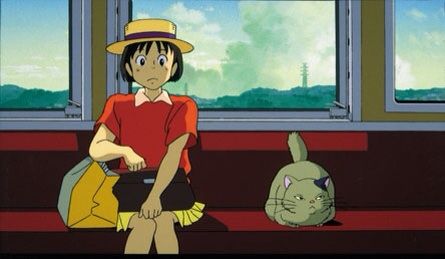
Animation often takes us on a magic carpet ride through a fantasy world. Minus a dream sequence or two, this film - written by Miyazaki and directed by Yoshifumi Kondo - has its feet firmly planted in reality. The attention to detail and observational representation is second to none, and the story of Shizuku Tsukishima, a 14-year-old girl trying to find her way as a writer, is carried out with remarkable competence. You might call it a fairy tale wrapped in reality. The urban world springs to life. Whisper of the Heart's strongest quality lies in the development of its characters. Every single one, from Shizuku to Seiji (her love interest) to her family members to her classmates and even to the cat riding on a subway car, is an individual with distinct traits. Each is on their own individual journey. Where those journeys overlap is the heart of the film.
I can't tell you highly I rate this film. There are not enough superlatives in the English language. I hadn't seen it until a month ago, and it is without a doubt my favorite animated movie. It may very well be my favorite movie...period. To quote The Sound of Music, this movie is "a drop of golden sun."
2. In This Corner of the World (2016)

Like their American counterparts, Japanese filmmakers often tell stories about World War II. Unlike Americans, the Japanese don't glorify themselves in the process. Their stories, for the most part, deal in defeat and tragedy. Grave of the Fireflies (1988) remains the prime example, though In This Corner of the World offers a different, and perhaps equally affecting, look at this period. To begin with, the art style is brilliant. All of it is hand-drawn, a rarity in today's CGI-dominated industry, and the result is stunning. The visuals provide an added depth to the story, which follows Suzu, a small-town girl with a talent for drawing. She is given in marriage to a young man and joins his family's household. The war and the constant threat of American bombers hang over her life. Everything comes from her perspective. As such, the movie begins and ends with the nuance and careful attention the filmmakers give to developing her character and the world she sees.
This one is the opposite of Whisper of the Heart. It's a heartbreaking tale, a character study of an individual who has much to offer the world, but not given the opportunity or allowed the agency to pursue her talents. Watching this (and Grave of the Fireflies) changed how I see war movies, though to define In This Corner of the World as simply a war movie would be to limit its scope.
3. Your Name (2016)

If Shinkai can delve deeper into his characters and truly bring them out as unique individuals, then he will be the one to pick up Miyazaki's mantle as the best filmmaker in Japanese animation once the old master retires for good. Everything else he does is damn near untouchable. Your Name is the best thing he has done so far and definitely deserves your time.
(Note: Your Name will be a household name in the near future. J.J. Abrams has a live-action adaptation in the works. Here's hoping the man behind many a sci-fi epic doesn't drop the ball.)
4. Summer Wars (2009)

Tell me if you've heard this story before. A teenage boy who seems unappreciated and doesn't know what he wants to do is forced into saving the virtual realm from falling into the hands of a nefarious enemy. Yes, I'm referring to Ready Player One - both the book and the movie. That story occupies a spot in the current pop culture consciousness, but Summer Wars predates the book. Mamoru Hosoda, another pretender to Miyazaki's throne, did it first (obviously, there are differences). The movie is a lot of fun and appears to have a sense of the ridiculous (the bad guy is called "Love Machine"). Its flaw, however, lies in the character development. There are too many characters who don't serve much of a purpose.
Action is cool. Stories about artificial intelligence and the future of the internet as the world's marketplace and a social sphere are in vogue. This should tickle that fancy. Also, watch it to see how it stacks up against Ready Player One. You might find out that it's that much better.
5. Only Yesterday (1991)

An animated film geared towards a serious adult sensibility, Only Yesterday plays like a product on the indie circuit. It tells the story of Taeko, a young woman who takes a trip to the countryside to pick safflowers the old-fashioned way. She also tackles the personal demons she's faced since the fifth grade, initiating flashbacks to key events from that period in her life. The film moves along at a slow pace, giving the audience time to breathe in Taeko's internal conflict and the scenic countryside that surrounds her. In a way, the movie serves as a love letter to agriculture and a world being left behind by a technologically oriented society, as it attempts to convince the audience that there will always be a place for farming despite the difficulties the industry faces.
In an alternate universe, this Studio Ghibli product would be as well known as the best of Miyazaki's work. Isao Takahata, a co-founder of Studio Ghibli, shows that animation isn't just for kids. It's flown under the radar and only recently received an English dub (featuring Daisy Ridley, no less), but few movies depict the "child is mother to the woman" (an inversion on a Wordsworth line) relationship so well.
---
Given that two of these are Studio Ghibli and one is from Makoto Shinkai, some people may find the list too mainstream, but films not made by Hayao Miyazaki and aren't Spirited Away often get overlooked, especially in America.
Feel free to leave a comment below and follow @WinBribach on Twitter.


