Showing posts with label Western. Show all posts

Monday, August 24, 2015

10 Great Screenplays: #5 The Man Who Shot Liberty Valance (1962)

When the name of director John Ford is mentioned, very seldomly does his 1962 work of art The Man Who Shot Liberty Valance come up. It, for whatever reason, is left to wander in the roads of relative obscurity. That's not saying the film wasn't a smashing success, but it is saying that the film does not receive the proper respect and notoriety it deserves. It might be cast off as just another western movie from the Hollywood assembly line with John Wayne in the lead, an assumption containing zero foundation.
John Wayne teaching James Stewart how to take the law into his own hands.
Maybe the greatest crime of all concerning this film is the lack of credit given to the writers, James Warner Bellah and Willis Goldbeck, who adapted a short story by Dorothy Johnson into a sparkling screenplay. They grabbed all the cliches that dominate the western scene, reworked them, ironed them out, and created something very unique. Sadly, the pair received no recognition from the Academy for their work.

Anyway, onto the story. U.S Senator Ransom Stoddard and his wife, Hallie, return home to the town of Shinbone for a funeral of an old friend, Tom Doniphon. This baffles the local newspapermen, who have no knowledge of Mr. Doniphon. The editor of the Shinbone Star demands a story from Stoddard, who obliges.

In flashback, he tells the story of how he happened to come to Shinbone and his initial encounter with the ruthless and vile Liberty Valance. Stoddard is robbed and whipped severely, but Doniphon comes to the rescue, bringing him to town for treatment. Here, Stoddard meets Hallie for the first time, though he believes her to be Doniphon's girl like everyone else does. 
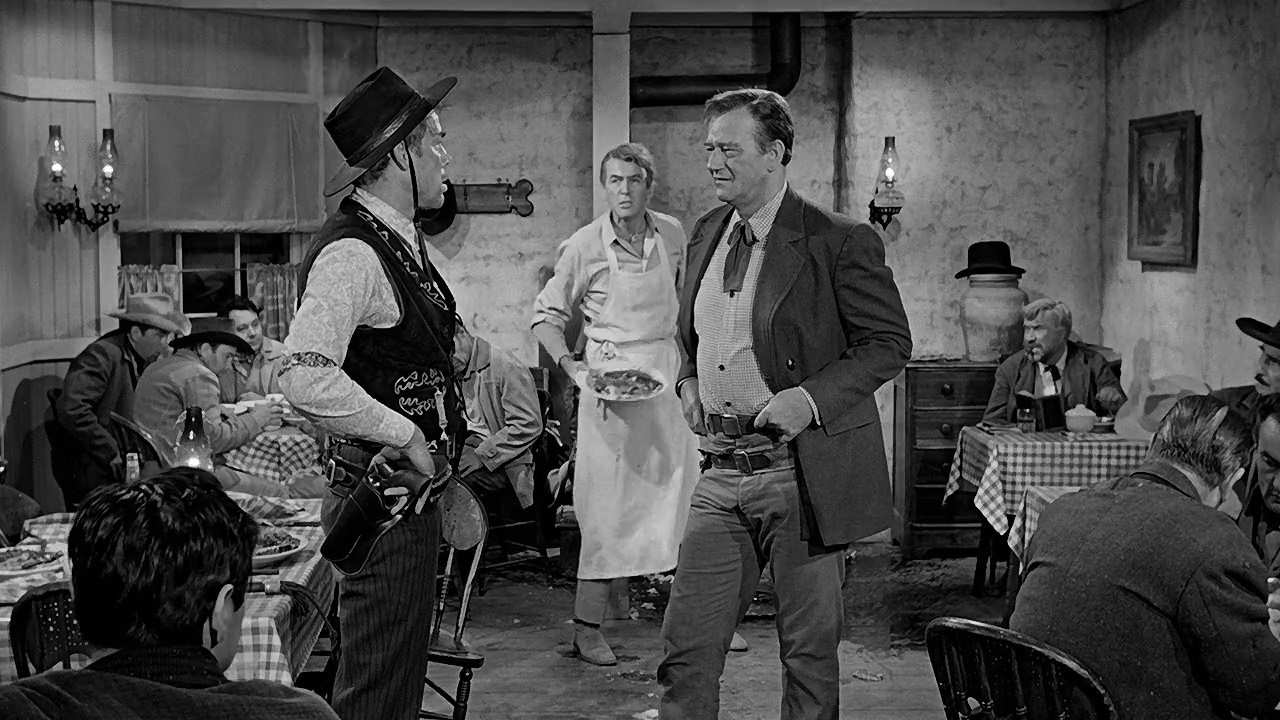
Left to right: Valence, Stoddard, and Doniphon.
Stoddard is given room and board at the restaurant where Hallie works in exchange for washing dishes. He also makes an effort to educate the illiterate townsfolk, including Hallie. Meanwhile, the vote for statehood is nearing and everyone knows the ranchers, who oppose statehood, have hired Liberty Valance to scare people from voting the "wrong" way. Although Stoddard received a taste of Liberty's medicine, he is determined to fight him.

At this point, Doniphon steps in and gives him a lesson about western law and order. It's being a better shot than the other guy. Stoddard hates this, but feels forced into a showdown with his enemy.

I'll leave the summary here to elaborate on the elements that make the writing so special. The Man Who Shot Liberty Valance may be the best singular showcase of the Western genre ever recorded on film. Everything about the popular genre, from law and order to changing times to the introduction of education, is on display and the result is wonderful.

Another point worth mentioning is the character of Tom Doniphon, who appears to be a supporting character, and how he is the true lead in the film. Every scene centers on him and he makes the story tick. Also, he provides a perfect analysis on the western hero. He's masculine, strong, and capable of making quick decisions, but he's not a stock or cliched character by any means. It's his sacrifice, not Stoddard's, that adds multiple layers to the story.
Who shot Liberty Valance?
Lastly, there's the famous line, "When the legend becomes fact, print the legend." This is the central theme of the story and it's holds a very singular place in the western sphere. Not only can it be applied to almost every tale in the western mythology, but also it's a new cliche. Something that the western had never quite covered before. 

Friday, August 21, 2015

10 Great Screenplays: #6 Butch Cassidy and The Sundance Kid (1969)

When I picture bank robbers and criminals, the last guys that come to mind are Robert Redford and Paul Newman. Those guys, by virtue of their popular image, were supposed to be the essence of cool. They have to look good, even at the expense of a solid acting performance. Then I saw Butch Cassidy and The Sundance Kid, and now I can't see the pair as anything else but a couple of bickering bandits.
Think ya used enough dynamite there, Butch?
Anyway, onto the screenplay. William Goldman, the imaginative author of The Princess Bride, delved into the pages of history with Butch Cassidy and The Sundance Kid. Butch and Sundance were the last of the great Western-style bandits, gunslingers who accomplished their deeds on horseback. Also, as Goldman portrays them, they were prone to light-hearted bickering and the occasional unnecessarily long frolicking escapade on a bike. 

The playful duo pull a couple of bank robberies and then danger comes, the kind of danger that says flee instead of stand and fight--a super posse. An angry railroad baron calls for their heads and assembles an unrivaled gang of lawmen and trackers to make sure they don't get away. Every time Butch and Sundance think they're free, the posse shows up, foiling any feelings of relief.
Who are those guys?
After a daring escape that involves a leap of faith, Butch and Sundance go to the only friend they've got, Etta Place. She's also Sundance's girl. At Butch's behest, they head south to Bolivia and find a very impoverished situation. Of course, they remedy this by robbing banks and pissing off the government. 

At the end of the day, Goldman's masterful screenplay is all about dialogue and every writer's friend, the monomyth. The dialogue, on top of completing it's primary purpose of moving the story forward, is simply dripping with wit. There are seemingly more moments that illicit laughter than there are moments of intense drama. In short, it's fun, it's got action, and it's got drama, and that's rare for a screenplay. Also, by virtue of being a Western, the Hero's journey or monomyth is on full display. Yes, every story contains the monomyth in some fashion, but here it is more prevalent. All the boxes are checked very clearly. Does that make it formulaic and unoriginal? 

Not in the slightest.