Showing posts with label TCM. Show all posts

Monday, August 24, 2015

10 Great Screenplays: #5 The Man Who Shot Liberty Valance (1962)

When the name of director John Ford is mentioned, very seldomly does his 1962 work of art The Man Who Shot Liberty Valance come up. It, for whatever reason, is left to wander in the roads of relative obscurity. That's not saying the film wasn't a smashing success, but it is saying that the film does not receive the proper respect and notoriety it deserves. It might be cast off as just another western movie from the Hollywood assembly line with John Wayne in the lead, an assumption containing zero foundation.
John Wayne teaching James Stewart how to take the law into his own hands.
Maybe the greatest crime of all concerning this film is the lack of credit given to the writers, James Warner Bellah and Willis Goldbeck, who adapted a short story by Dorothy Johnson into a sparkling screenplay. They grabbed all the cliches that dominate the western scene, reworked them, ironed them out, and created something very unique. Sadly, the pair received no recognition from the Academy for their work.

Anyway, onto the story. U.S Senator Ransom Stoddard and his wife, Hallie, return home to the town of Shinbone for a funeral of an old friend, Tom Doniphon. This baffles the local newspapermen, who have no knowledge of Mr. Doniphon. The editor of the Shinbone Star demands a story from Stoddard, who obliges.

In flashback, he tells the story of how he happened to come to Shinbone and his initial encounter with the ruthless and vile Liberty Valance. Stoddard is robbed and whipped severely, but Doniphon comes to the rescue, bringing him to town for treatment. Here, Stoddard meets Hallie for the first time, though he believes her to be Doniphon's girl like everyone else does. 
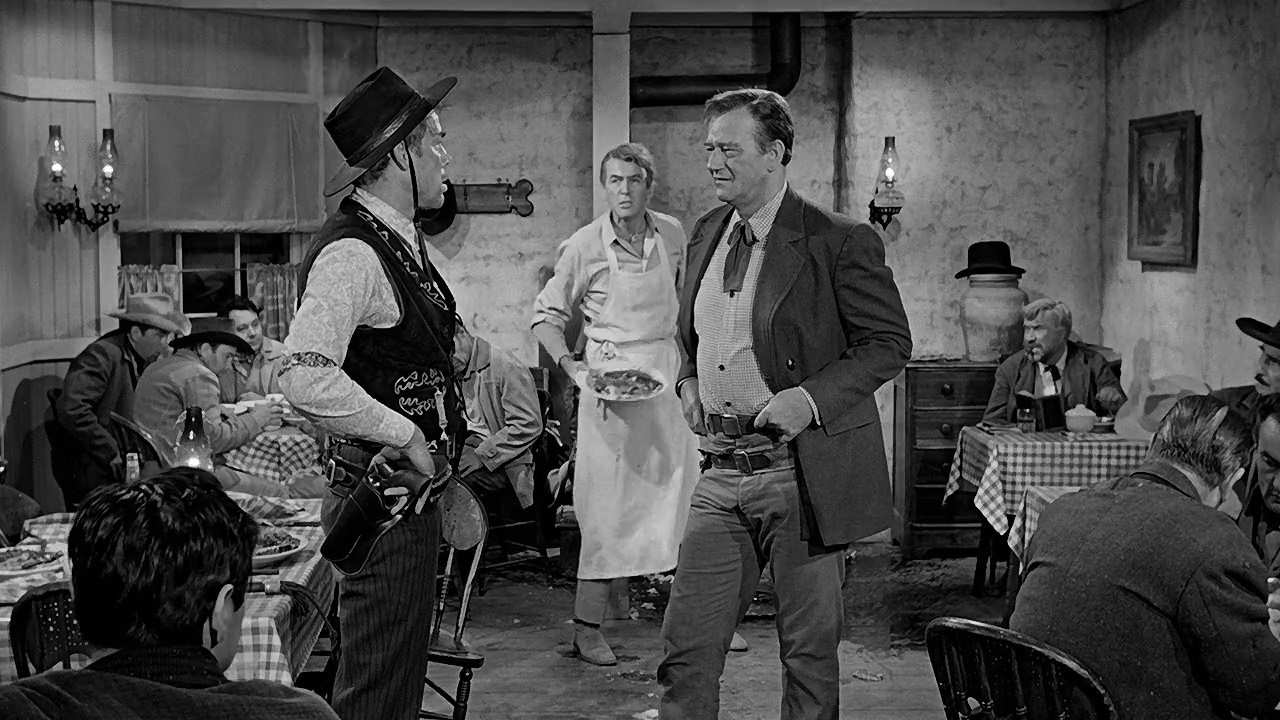
Left to right: Valence, Stoddard, and Doniphon.
Stoddard is given room and board at the restaurant where Hallie works in exchange for washing dishes. He also makes an effort to educate the illiterate townsfolk, including Hallie. Meanwhile, the vote for statehood is nearing and everyone knows the ranchers, who oppose statehood, have hired Liberty Valance to scare people from voting the "wrong" way. Although Stoddard received a taste of Liberty's medicine, he is determined to fight him.

At this point, Doniphon steps in and gives him a lesson about western law and order. It's being a better shot than the other guy. Stoddard hates this, but feels forced into a showdown with his enemy.

I'll leave the summary here to elaborate on the elements that make the writing so special. The Man Who Shot Liberty Valance may be the best singular showcase of the Western genre ever recorded on film. Everything about the popular genre, from law and order to changing times to the introduction of education, is on display and the result is wonderful.

Another point worth mentioning is the character of Tom Doniphon, who appears to be a supporting character, and how he is the true lead in the film. Every scene centers on him and he makes the story tick. Also, he provides a perfect analysis on the western hero. He's masculine, strong, and capable of making quick decisions, but he's not a stock or cliched character by any means. It's his sacrifice, not Stoddard's, that adds multiple layers to the story.
Who shot Liberty Valance?
Lastly, there's the famous line, "When the legend becomes fact, print the legend." This is the central theme of the story and it's holds a very singular place in the western sphere. Not only can it be applied to almost every tale in the western mythology, but also it's a new cliche. Something that the western had never quite covered before. 

Tuesday, August 18, 2015

10 Great Screenplays: #7 The Best Years of Our Lives (1946)

In some people's books, including my own, William Wyler's post-WWII masterpiece The Best Years of Our Lives may possibly be the finest film ever made. From beginning to end, the movie is simply splendid. The acting is wonderful, the direction is borderline perfect, and the writing is strictly top of the pile stuff. I could gush and awe over all of these aspects (a very special shout-out to Harold Russell, a guy who lost his hands in the war, for a beautiful performance), but, as my focus lies in the screenplay, I will stick to the writing.
Two well deserved Oscars.
Robert Sherwood, a Pulitzer Prize winning playwright, was called in to write the screenplay based on famed novelist MacKinlay Kantor's (author of Andersonville) massively long treatment that Kantor turned into a novel titled Glory for Me. He took the material and crafted one of the most unique screenplays ever written (I'll get to that in a bit). It centers around a very simple premise--three guys returning home from the war.

As you may surmise, the story is all about character. In fact, interestingly enough, there is no clear-cut antagonist in this film. Each of the soldiers are returning to an entirely changed America, one that will try to "rehabilitate" them at every opportunity.

The first man to return home is Homer Parrish, a Navy man. He lost his hands in the war and his family takes it very hard, especially his mother. His fiancee Wilma, however, is just glad her man is safely home. Still, Homer has difficulty adjusting to his new circumstances and how everyone looks upon him with pity (except Wilma). He is irritable, driving almost everyone away from him, and his confidence is shot.
The next guy to walk through his own front door is Army man, Al Stephenson, who appears to be returning home to the most pleasant conditions. His wife loves him, his children adore him, and he has immediately been promoted to Vice President and given a raise at the bank in which he works. Even so, he wants to make a difference in the lives of the numerous military men while they re-adjust to civilian life. His ideas are met with skepticism by the bank president and others who work with him, but Al maintains he will continue approving loans for servicemen where "sufficient collateral" isn't shown. 

Then there's Fred Derry, who spent the war as a bombardier in the Army Air Force. He's coming home to a wife he knew for only a short time before getting sent overseas and virtually no prospect of a good job. After some struggle in locating his wife, he finds that she has gotten a job as a night club dancer. They are reunited and they spend his severance pay very lavishly. His wife, Marie, is very materialistic and shows no understanding for his PTSD. 
A faithful wife?
On the other hand, Al's daughter, Peggy shows a great deal of patience and kindness towards Fred. Although reluctant to admit at first, she has fallen in love with the married pilot and can't shake herself out of those feelings. 

All of these elements bring about a wonderful amount of conflict and allows the audience to delve deeply into the emotions of the characters involved. Relationships are strained, new ones are formed, and struggles are very much prevalent. Two tent poles around which Hollywood has been pitched since Edison got kicked out of the business; relationships and conflict.
A wonderful showcase of deep focus cinematography.
Okay, here's where I get back to the uniqueness of Robert Sherwood's screenplay. For one thing, there is no physical antagonist. It's different for each character and it connects with the idea of rehabilitating oneself to a world that has changed and moved on. No great mercy is bestowed upon the men who fought to preserve the nation from the tyrannical Adolf Hitler and Hiro Hito. 

This is one of the central themes, and it plays into the meaning of the title, which is taken from one of Marie Derry's lines. The best years of these servicemen's lives were spent overseas fighting the war. They can't get them back and they have to do the best they can in the tough years ahead.