Thursday, August 16, 2018

Crazy Rich Asians Isn't So Crazy After All

Crazy Rich Asians poster.png


Rich guy and not-so-rich girl fall in love and encounter obstacles including but not limited to: unwelcoming family members, elitism, classist assumptions, and that douchebag everyone hates. Let's be honest, we've all seen some iteration of that story. Some may say they liked it better when it was called Pride and Prejudice or Cinderella. The point is: Crazy Rich Asians is nowhere near crazy where the storytelling is concerned. 

Don't get me wrong, romantic comedies work partially because of the paradigm and because of the familiar situations the characters get put into. They're like coming home after an 8-hour shift at the office and seeing your cat mark the shoe-rack for the umpteenth time. You've grown accustomed to it. Memorable romcoms, however, have distinct characters that you remember long after the movie has ended.

Crazy Rich Asian doesn't even have that. 

Take Nicholas Young (Henry Golding), for example. He's an intelligent dude. He was born into a rich, elitist family, but he's nothing like his family. Rather than a snob, Nick has become an all-around good egg, a nice dude who is head over heels in love with his girlfriend and wants the relationship to go to the next level. His defining qualities are his billion dollar smile and a heart of gold. 

Those traits don't sound overly unique. 

Rachel Chu (Constance Wu) has a little more substance to work with, but even she is bogged down by certain genre tropes. When it's all said and done, she's the hardworking girl with the gumption and the fight to prove to her boyfriend's family that she is more than good enough for their son. 

Both characters' traits point to a common theme in romantic comedies -- the leads are usually the least interesting people. The entertainment comes from the surroundings, the situation, and the colorful supporting cast. That's what happens here. 

Jon Chu sets up lavish sequence after lavish sequence. He takes us from the night market to an upscale hotel to McMansions to a private island and to that douchebag shooting a bazooka off a ship into the ocean. The pacing is quick. The movie doesn't get bogged down by explaining the details behind everything in the family dynamic. 

Michelle Yeoh, primarily known for her work in Crouching Tiger, Hidden Dragon, and other martial arts films, puts in the strongest performance as Nick's traditionalist mother. She provides a necessary counterbalance to the laid-back ease and open-mindedness of other members of her family and has just enough nuance to keep the character from falling into the hard-line generic Chinese mother role. Gemma Chan, as Nick's cousin and his and Rachel's confidant, also adds poise to the screen.

For the off-beat and quirky stuff, Awkwafina and Ken Jeong and the cousin who is always concerned with "optimal angles" have you covered. Like anything in that brand of humor, it can be an acquired taste and is often hit-and-miss. 

It's pretty clear that Crazy Rich Asians isn't pushing any storytelling envelopes. It's slick, it's efficient and adequate entertainment. 

Asian leads and Asian faces, however, make the movie an outlier. Seldom does Hollywood give Westernized Asian actors a chance to be the romantic heroes. The project is a major step forward for Asian representation in Hollywood. That is this movie's primary value. Its success will open doors for more movies, and most certainly, better ones. 

If this leads to Hotel On the Corner of Bitter and Sweet (do yourself a favor and read the book) finally getting the green light, an Asian-led live-action version of Your Name, and adaptations of Native Speaker, Chinglish, and other purely original projects (maybe one of mine lol), then Crazy Rich Asians will have done its job. 

(P.S The book is 300% better than the movie.) 

Saturday, May 26, 2018

Solo: A Star Wars Story (We've Seen Before)

Image result for solo

Han Solo takes his cues from the classics. He’s one-part John Wayne, two parts Captain Blood, and a drop of James Cagney. Rather than solve his problems in a calm, rational manner, he’d rather whip out his blaster or crack a (somewhat cornball) one-liner about not understanding Princess Leia. His heart of gold, however, refuses to leave a lost cause alone.

More than that, he likes to improvise. Han revels in breaking the rules, going outside the box, and manages to work things out despite not hitting all the checkboxes when they’re supposed to be hit. This freewheeling essence, in theory, should be at heart of Solo: A Star Wars Story.

Instead, Solo operates like a car (or spaceship) fresh off the assembly line. The engine runs smooth, the different mechanical parts work in the way they are supposed to, and there are no hiccups in the latest technology to ruin the experience. No problem, right? For a vehicle, sure. A movie, however, needs a little nuance and narrative invention.

That is nowhere to be found.

The Kasdans’ screenplay feels rote rather than robust. Ron Howard’s direction is distinctly uninspired. Given what appears to be his most well-remembered movie, A Beautiful Mind – which borrowed heavily from the film noir aesthetic and other Hollywood tropes – it should come as no surprise that he does the same with Solo and shamelessly.

The movie takes the worst quality of the Star Wars franchise – the strict adherence to the Joseph Campbell formula and the rehashing of plot points seen in old sci-fi films and westerns – and makes that the foundation. How many times have we seen the “destroy the Death Star” plot? At least four, perhaps more.

To be fair, Solo has its brighter moments. Almost all of them come from the cast. Alden Ehrenreich is not Harrison Ford, and it shows. He may not have the same charm, but he has enough to make him a passable Han Solo. Emilia Clarke, who plays Qi’ra, Solo’s love interest, puts in a solid performance. Woody Harrelson almost makes you forget that his character resembles every other on-screen bandit nearing their career’s end.

Donald Glover’s Lando Calrissian puts them both to shame. The man possesses a particular set of skills; skills that make him and his abundant charisma an enjoyable watch whenever he appears on the screen.

Following another common theme in the Star Wars universe, the most colorful and interesting character is not a human. It’s a robot. L3-37 (Phoebe Waller-Bridge) commands every scene she is in. She provides much-needed humor, energy, and personality. She could also teach Korg a thing or two about starting a revolution. Without her, the movie would be flatter than a tabletop.

The cast makes the movie watchable.

At the end of the day, Solo is what the Old Hollywood studios would call “harmless entertainment.” No attempts to convey a deeper message beyond the tale. A one-dimensional good-guy, bad-guy plot.


Pure escapism. 

Follow @WinBribach on twitter. 

Tuesday, May 1, 2018

5 Japanese Animated Movies You May Have Missed (and Shouldn't Have)

Until recently, my knowledge of anime was limited to Dragonball (AAAAAAAHHHHHHH!!! Damn it, still not a Super Saiyan.) and the most high-profile films directed by Hayao Miyazaki. Then, Dragonball Super ended. The series left a bad taste in my mouth, especially the Goku Black/Infinite Zamasu saga, so I decided to see what else the Japanese canon had to offer.

I could make a list of the five best, but they would all be Miyazaki films and that's no fun, so I made this instead.

1. Whisper of the Heart (1995)

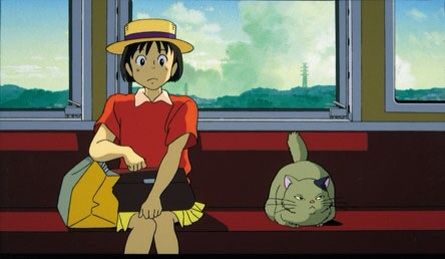
Image result for whisper of the heart moon

Animation often takes us on a magic carpet ride through a fantasy world. Minus a dream sequence or two, this film - written by Miyazaki and directed by Yoshifumi Kondo - has its feet firmly planted in reality. The attention to detail and observational representation is second to none, and the story of Shizuku Tsukishima, a 14-year-old girl trying to find her way as a writer, is carried out with remarkable competence. You might call it a fairy tale wrapped in reality. The urban world springs to life. Whisper of the Heart's strongest quality lies in the development of its characters. Every single one, from Shizuku to Seiji (her love interest) to her family members to her classmates and even to the cat riding on a subway car, is an individual with distinct traits. Each is on their own individual journey. Where those journeys overlap is the heart of the film.

I can't tell you highly I rate this film. There are not enough superlatives in the English language. I hadn't seen it until a month ago, and it is without a doubt my favorite animated movie. It may very well be my favorite movie...period. To quote The Sound of Music, this movie is "a drop of golden sun."

2. In This Corner of the World (2016)


Image result for in this corner of the world


Like their American counterparts, Japanese filmmakers often tell stories about World War II. Unlike Americans, the Japanese don't glorify themselves in the process. Their stories, for the most part, deal in defeat and tragedy. Grave of the Fireflies (1988) remains the prime example, though In This Corner of the World offers a different, and perhaps equally affecting, look at this period. To begin with, the art style is brilliant. All of it is hand-drawn, a rarity in today's CGI-dominated industry, and the result is stunning. The visuals provide an added depth to the story, which follows Suzu, a small-town girl with a talent for drawing. She is given in marriage to a young man and joins his family's household. The war and the constant threat of American bombers hang over her life. Everything comes from her perspective. As such, the movie begins and ends with the nuance and careful attention the filmmakers give to developing her character and the world she sees.

This one is the opposite of Whisper of the Heart. It's a heartbreaking tale, a character study of an individual who has much to offer the world, but not given the opportunity or allowed the agency to pursue her talents. Watching this (and Grave of the Fireflies) changed how I see war movies, though to define In This Corner of the World as simply a war movie would be to limit its scope.

3. Your Name (2016)


Related image

This might be stretching the "you may have missed" part a bit since it made a lot of money, but I'm including this instant classic anyway. The film's director, Makoto Shinkai, does not have a high profile distribution deal with an American studio, like Studio Ghibli and Disney, so his work may go largely unnoticed here in the United States. That needs to change, ASAP. Shinkai's talent and skill are off the charts. Your Name is exhibit A. The animation quality is unbelievable. Some scenes seem to be there just to show off how beautiful it is to look at. Also, the story of a rural girl and an urban boy who, for some odd reason, start switching bodies checks all the boxes where construction is concerned. It moves forward at a brisk pace and contains solid humor, welcome changes to Shinkai's usual brooding, melancholic meditations on the pains of modern Japanese life.

If Shinkai can delve deeper into his characters and truly bring them out as unique individuals, then he will be the one to pick up Miyazaki's mantle as the best filmmaker in Japanese animation once the old master retires for good. Everything else he does is damn near untouchable. Your Name is the best thing he has done so far and definitely deserves your time.

(Note: Your Name will be a household name in the near future. J.J. Abrams has a live-action adaptation in the works. Here's hoping the man behind many a sci-fi epic doesn't drop the ball.)

4. Summer Wars (2009)

Image result for summer wars

Tell me if you've heard this story before. A teenage boy who seems unappreciated and doesn't know what he wants to do is forced into saving the virtual realm from falling into the hands of a nefarious enemy. Yes, I'm referring to Ready Player One - both the book and the movie. That story occupies a spot in the current pop culture consciousness, but Summer Wars predates the book. Mamoru Hosoda, another pretender to Miyazaki's throne, did it first (obviously, there are differences). The movie is a lot of fun and appears to have a sense of the ridiculous (the bad guy is called "Love Machine"). Its flaw, however, lies in the character development. There are too many characters who don't serve much of a purpose.

Action is cool. Stories about artificial intelligence and the future of the internet as the world's marketplace and a social sphere are in vogue. This should tickle that fancy. Also, watch it to see how it stacks up against Ready Player One. You might find out that it's that much better.

5. Only Yesterday (1991)


Image result for only yesterday

An animated film geared towards a serious adult sensibility, Only Yesterday plays like a product on the indie circuit. It tells the story of Taeko, a young woman who takes a trip to the countryside to pick safflowers the old-fashioned way. She also tackles the personal demons she's faced since the fifth grade, initiating flashbacks to key events from that period in her life. The film moves along at a slow pace, giving the audience time to breathe in Taeko's internal conflict and the scenic countryside that surrounds her. In a way, the movie serves as a love letter to agriculture and a world being left behind by a technologically oriented society, as it attempts to convince the audience that there will always be a place for farming despite the difficulties the industry faces.

In an alternate universe, this Studio Ghibli product would be as well known as the best of Miyazaki's work. Isao Takahata, a co-founder of Studio Ghibli, shows that animation isn't just for kids. It's flown under the radar and only recently received an English dub (featuring Daisy Ridley, no less), but few movies depict the "child is mother to the woman" (an inversion on a Wordsworth line) relationship so well.

---

Given that two of these are Studio Ghibli and one is from Makoto Shinkai, some people may find the list too mainstream, but films not made by Hayao Miyazaki and aren't Spirited Away often get overlooked, especially in America.

Feel free to leave a comment below and follow @WinBribach on Twitter.