Showing posts with label Emilia Clarke. Show all posts

Friday, November 8, 2019

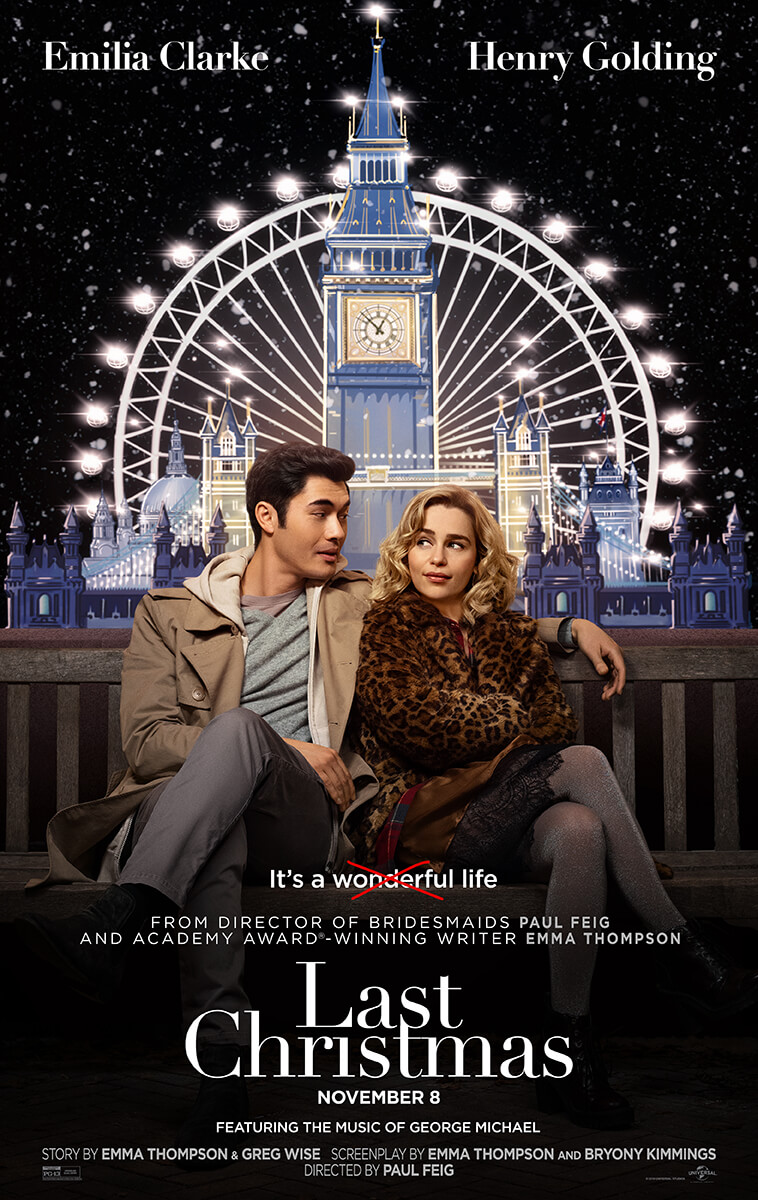
Last Christmas I (Literally) Gave You My Heart


Image result for last christmas poster"

 *Opens Christmas Movie Recipe*

- Classic Christmas tunes (Preferably sung by cast members)
- Romance
- Quirky characters obsessed with the spirit of Christmas
- An initially cynical lead who is charmed by their festive surroundings
- Likability
- Overt (and sometimes obvious) life lessons
- Heart (elusive but necessary)
- Poverty (optional)

*Returns Recipe to Hallmark*

I have always had a soft spot for Christmas movies. If anything, they are an excuse to indulge in the comfortable and cheery tunes that mark the holiday season. Right around my birthday, I turn on the movies I’ve seen countless times – Holiday Inn, White Christmas, and It’s a Wonderful Life – the movies that created the formula that we have now become ultra-familiar with.

Last Christmas is a highly engineered attempt to capture the elements audiences expect from the genre and offer a mild twist. Even with talented (or at least prominent) individuals on board, I came into the movie with low expectations – these sorts of things are often imitations of classics and having high expectations is masochistic. Still, I left the theater having been let down. The movie doesn’t have the cheer to make up for its massive shortcomings.

The largest humbug is the story. Emma Thompson can write. Her screenplay of Sense and Sensibility is fantastic. Creating a formulaic yet pleasant enough story seems like a reasonable expectation. It never quite gets there. Emilia Clarke’s character is ailing in body and soul when we first meet her, and following a few chance encounters with a guardian angel-like Henry Golding – can someone please get this guy a more than one-note role? He has all the makings of a star – she’s having a holly jolly Christmas. The twist ending falls flat.

That, however, is not the worst part of the story. It is everything around them. The Christmas emporium run by Michelle Yeoh (this is a Crazy Rich Asians reunion) has the right quirk, but scenes depicting her as a giddy schoolgirl at heart come across empty and lack the humor they were going for. The last part is especially prescient, as there isn’t even enough humor in the story to bring a half-smile across your face, let alone laughter.

Without the humor, the little moments in the movie meant to elevate it beyond simple Christmas fare don’t have the punch they need. The film is very apparent in its lack of sympathy for Brexit yet the film’s politics seem shoehorned in, and it’s not just the nonexistent laughs. The story relies heavily on immigrant stereotypes. They are poor, isolated, and speak with an accent and sing songs from the old country, and they are meant to be pitied. Some things, even in a Christmas movie, cannot be oversimplified.

Because there are so many problems in the story and how the characters are conceived, passing judgement on the acting is difficult. Clarke soldiers on, trying to make the most of it, and trying to make it seem like her transformation is earned. Golding and Yeoh also do their best, while the rest are little more than window dressing.

I also want to take issue with the title. If the creatives behind the film weren’t so invested in an all too literal interpretation of the titular song’s opening line, then they should’ve named it Change of Heart. Alas, a missed opportunity. 

Saturday, May 26, 2018

Solo: A Star Wars Story (We've Seen Before)

Image result for solo

Han Solo takes his cues from the classics. He’s one-part John Wayne, two parts Captain Blood, and a drop of James Cagney. Rather than solve his problems in a calm, rational manner, he’d rather whip out his blaster or crack a (somewhat cornball) one-liner about not understanding Princess Leia. His heart of gold, however, refuses to leave a lost cause alone.

More than that, he likes to improvise. Han revels in breaking the rules, going outside the box, and manages to work things out despite not hitting all the checkboxes when they’re supposed to be hit. This freewheeling essence, in theory, should be at heart of Solo: A Star Wars Story.

Instead, Solo operates like a car (or spaceship) fresh off the assembly line. The engine runs smooth, the different mechanical parts work in the way they are supposed to, and there are no hiccups in the latest technology to ruin the experience. No problem, right? For a vehicle, sure. A movie, however, needs a little nuance and narrative invention.

That is nowhere to be found.

The Kasdans’ screenplay feels rote rather than robust. Ron Howard’s direction is distinctly uninspired. Given what appears to be his most well-remembered movie, A Beautiful Mind – which borrowed heavily from the film noir aesthetic and other Hollywood tropes – it should come as no surprise that he does the same with Solo and shamelessly.

The movie takes the worst quality of the Star Wars franchise – the strict adherence to the Joseph Campbell formula and the rehashing of plot points seen in old sci-fi films and westerns – and makes that the foundation. How many times have we seen the “destroy the Death Star” plot? At least four, perhaps more.

To be fair, Solo has its brighter moments. Almost all of them come from the cast. Alden Ehrenreich is not Harrison Ford, and it shows. He may not have the same charm, but he has enough to make him a passable Han Solo. Emilia Clarke, who plays Qi’ra, Solo’s love interest, puts in a solid performance. Woody Harrelson almost makes you forget that his character resembles every other on-screen bandit nearing their career’s end.

Donald Glover’s Lando Calrissian puts them both to shame. The man possesses a particular set of skills; skills that make him and his abundant charisma an enjoyable watch whenever he appears on the screen.

Following another common theme in the Star Wars universe, the most colorful and interesting character is not a human. It’s a robot. L3-37 (Phoebe Waller-Bridge) commands every scene she is in. She provides much-needed humor, energy, and personality. She could also teach Korg a thing or two about starting a revolution. Without her, the movie would be flatter than a tabletop.

The cast makes the movie watchable.

At the end of the day, Solo is what the Old Hollywood studios would call “harmless entertainment.” No attempts to convey a deeper message beyond the tale. A one-dimensional good-guy, bad-guy plot.


Pure escapism. 

Follow @WinBribach on twitter.