Tuesday, August 18, 2015

10 Great Screenplays: #7 The Best Years of Our Lives (1946)

In some people's books, including my own, William Wyler's post-WWII masterpiece The Best Years of Our Lives may possibly be the finest film ever made. From beginning to end, the movie is simply splendid. The acting is wonderful, the direction is borderline perfect, and the writing is strictly top of the pile stuff. I could gush and awe over all of these aspects (a very special shout-out to Harold Russell, a guy who lost his hands in the war, for a beautiful performance), but, as my focus lies in the screenplay, I will stick to the writing.
Two well deserved Oscars.
Robert Sherwood, a Pulitzer Prize winning playwright, was called in to write the screenplay based on famed novelist MacKinlay Kantor's (author of Andersonville) massively long treatment that Kantor turned into a novel titled Glory for Me. He took the material and crafted one of the most unique screenplays ever written (I'll get to that in a bit). It centers around a very simple premise--three guys returning home from the war.

As you may surmise, the story is all about character. In fact, interestingly enough, there is no clear-cut antagonist in this film. Each of the soldiers are returning to an entirely changed America, one that will try to "rehabilitate" them at every opportunity.

The first man to return home is Homer Parrish, a Navy man. He lost his hands in the war and his family takes it very hard, especially his mother. His fiancee Wilma, however, is just glad her man is safely home. Still, Homer has difficulty adjusting to his new circumstances and how everyone looks upon him with pity (except Wilma). He is irritable, driving almost everyone away from him, and his confidence is shot.
The next guy to walk through his own front door is Army man, Al Stephenson, who appears to be returning home to the most pleasant conditions. His wife loves him, his children adore him, and he has immediately been promoted to Vice President and given a raise at the bank in which he works. Even so, he wants to make a difference in the lives of the numerous military men while they re-adjust to civilian life. His ideas are met with skepticism by the bank president and others who work with him, but Al maintains he will continue approving loans for servicemen where "sufficient collateral" isn't shown. 

Then there's Fred Derry, who spent the war as a bombardier in the Army Air Force. He's coming home to a wife he knew for only a short time before getting sent overseas and virtually no prospect of a good job. After some struggle in locating his wife, he finds that she has gotten a job as a night club dancer. They are reunited and they spend his severance pay very lavishly. His wife, Marie, is very materialistic and shows no understanding for his PTSD. 
A faithful wife?
On the other hand, Al's daughter, Peggy shows a great deal of patience and kindness towards Fred. Although reluctant to admit at first, she has fallen in love with the married pilot and can't shake herself out of those feelings. 

All of these elements bring about a wonderful amount of conflict and allows the audience to delve deeply into the emotions of the characters involved. Relationships are strained, new ones are formed, and struggles are very much prevalent. Two tent poles around which Hollywood has been pitched since Edison got kicked out of the business; relationships and conflict.
A wonderful showcase of deep focus cinematography.
Okay, here's where I get back to the uniqueness of Robert Sherwood's screenplay. For one thing, there is no physical antagonist. It's different for each character and it connects with the idea of rehabilitating oneself to a world that has changed and moved on. No great mercy is bestowed upon the men who fought to preserve the nation from the tyrannical Adolf Hitler and Hiro Hito. 

This is one of the central themes, and it plays into the meaning of the title, which is taken from one of Marie Derry's lines. The best years of these servicemen's lives were spent overseas fighting the war. They can't get them back and they have to do the best they can in the tough years ahead.

Sunday, August 16, 2015

10 Great Screenplays: #8 Dr. Strangelove or: How I Learned to Stop Worrying and Love the Bomb

I will begin by saying that the screenplay for Dr. Strangelove or: How I Learned to Stop Worrying and Love the Bomb is classic Stanley Kubrick, who co-wrote it with satirical novelist and screenwriter, Terry Southern. For one thing, the draft available for reading runs to an astoundingly low number of 55 pages. The accepted standard in the film industry is one page for every minute of screen time, yet the screenplay for Dr. Strangelove is about half the length of a usual feature film script. It's about as long as a pilot for a TV Drama, yet the final produced film runs for 103 minutes or 1 hour and 43 minutes. Kubrick was never one to follow the Hollywood norms.

Yee-haw! Hollywood!
Now onto the story...er...rather the situation. A general, Jack Ripper (whose middle name I like to think is "the"), decides to go rogue and activate a "fail-safe" command to order a nuclear attack on the Soviets. He takes every precaution against possible reversal, shutting down all forms of communication and tells his men to shoot anyone who tries to enter, as the enemy might be masquerading in American uniforms. Naturally, this would cause quite an uproar in the chain of command.President Merkin Muffley calls in every high ranking military officer, including Buck Turgidson (at an inopportune time) and the highly mysterious ex-Nazi, Dr. Strangelove.

Do you really need me in the War Room? 
They discuss possible ways of stopping the attack, but Turgidson constantly says it can't be done. Ripper is the only one who knows the code and he has excommunicated himself from the outside world. Eventually, Muffley orders a base commander to do whatever he can to get into Ripper's base. 

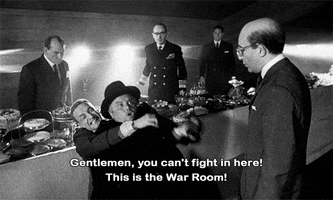
Also, while the men are trying to contact the Soviet Premier Kissov over the phone, Muffley announces that a Soviet Ambassador will be allowed into the War Room. This angers General Turgidson, who engages in fisticuffs with the perceived intruder upon seeing him. Apparently, such behavior is forbidden in the peaceful confines of the War Room. 
Need I say anyrhing?
After letting the Premier know what is about to go down, the ambassador announces that the "doomsday machine" will be activated if a nuclear bomb reaches Soviet soil. Panic has set in. Shifting between the plane (led by Major Kong) nearing its target, Ripper's office, and the War Room, events unfold which lead to only one thing--massive annihilation.

In the end, Dr. Strangelove explains a plan that will see the survival the human race (This differs from the movie, it happens much earlier on).

Why the short summary? Once again, the screenplay was very short and there's really not a whole lot to the general outlay of the plot. What makes it so special is the dialogue and the wonderful use of satire. Irony, a necessary component of satire, is all over the place and makes for laughs amidst the seemingly serious action. Not many writers and filmmakers are capable of doing such a beautiful job. It's like I said, Kubrick never was one to follow the Hollywood norms.

P.S Terry Southern definitely deserves some love for his work on the screenplay. Kubrick hired him after reading The Magic Christian, Southern's satirical novel. 

P.P.S Dr. Strangelove is based on the novel, Red Alert, by Peter George.

Friday, August 14, 2015

10 Great Screenplays: #9 Good Will Hunting (1997)

Good Will Hunting, a screenplay by Matt Damon and Ben Affleck. Wait...what? These two actors, who get more notoriety for their looks than their acting chops, actually wrote themselves one heck of a screenplay. And to think it all started as an idea Damon got in a Harvard English class, where he wrote a 40-page "treatment" (detailed summary, scenes and dialogue optional). Affleck, Damon's childhood friend, helped with the idea and even dropped out of college when a creative writing professor ridiculed the idea. Then, after getting a part in an unsuccessful movie, Damon moved in with Affleck in Los Angeles. He was only semester shy of getting his Harvard degree.

In short, Good Will Hunting was a passion project for them. They believed in it strongly enough and had a surplus of guts to see their idea through. Not many would drop out of school because a professor didn't like their story and even less would leave Harvard with only one semester to go, but they did. I'm pretty sure they don't regret doing so.

Hey professor! Look who's ridiculous now!
Anyway, onto the screenplay.

This story is all about character and it is all about the journey to self-enlightenment. Will Hunting, the titular protagonist, is an out-and-out genius. He has what appears to be a photographic memory and snaps off complicated combinatorics (complex mathematics) that a Fields Medal winner of an M.I.T Professor even stumbles on. Life's good, right? Wrong. Will has attachment issues, the byproduct of being abused by multiple foster parents, and he is afraid of caring, afraid of rejection.

Professor Lambeau brings Will to a psychologist friend of his, Sean McGuire, after other therapists refuse to work with Will. McGuire, a man grieving over the loss of his beloved wife, takes on the challenge that is Mr. Hunting. He finds himself opening up to Will and they slowly become good friends, but Will insists on holding back. 

Enter Skylar, the soon-to-be Med student who captures Will's heart. She's fun, intelligent, and can tell a mean joke. She falls for Will and wants nothing more than to give a long-term relationship a chance. He, however, still has problems with committing. The scars of his childhood persist in bothering him.

He has a few trusted friends, especially Chuckie, a blue-collar construction worker with a definitely blue-collar vocabulary. They are his comfort zone.

Can Will overcome his problems? Can Sean move on from his state of grief? Can Sean break Will's defenses? And can Skylar convince him to follow through with their budding relationship?

All of these questions result in beautifully organic situations of conflict. A battle of wills (:P) between Will and Sean, which forces the two of them to dig deep and find out who they really are and what they really want. This is what Good Will Hunting is all about--discovering what truly matters in life and having the courage to pursue it. 

Simply put, the story is character, conflict, and a little thing called heart. Well done Ben and Matt (sorry Ben and Jerry).