Saturday, April 28, 2018

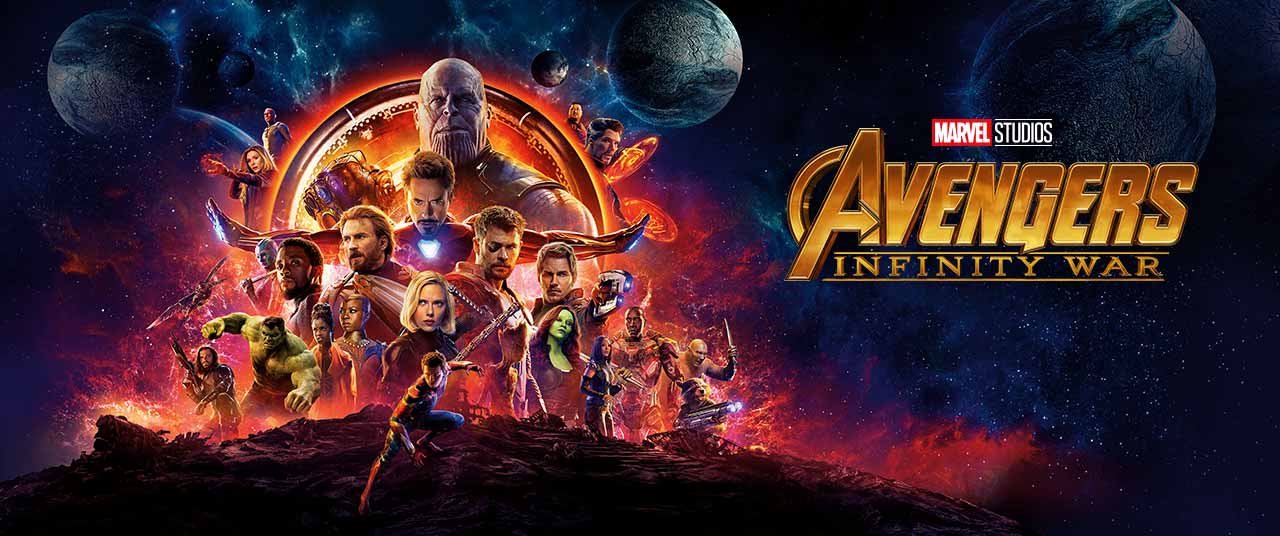
Too Big To Fail - Avengers: Infinity War Review

Image result for infinity war


Alfred Hitchcock defined suspense as involving dramatic irony, letting the audience in on the danger facing the heroes and building the tension from there. He considered this superior to surprise, where the audience knows nothing before the trap is sprung, but he did allow an exception: where the twist or shock is "the highlight of the story."

Avengers: Infinity Wars relies heavily on that exception.

The unfolding of the story revolves around surprise. Without it, there are no stakes, no emotional core, and no reason to make the movie besides adding another mega money maker to the Disney machine.

Before going further into the movie itself, the challenges must be mentioned. During the past 10 years, there have been 18 installments in the Marvel Cinematic Universe and 14 different directors. Of those directors, Ryan Coogler, Kenneth Branagh (old enough to make King Lear now), and Taika Waititi could be considered "Auteurs" - filmmakers who leave a distinct stamp on their work. Shane Black and James Gunn also possess a certain uniqueness. Fitting these visions into a single, cohesive movie is a difficult task, and the Russo brothers are mostly successful.

The movie operates like an episode of a TV show, with an A, B, C, and D story. Each plotline involves separate characters, giving them enough time to be relevant players in the grand scheme. That said, the movie would be overstuffed at half the characters. Age of Ultron proved that. There are too many players and too many stories, and not enough time. Some scenes feel thrown-in just to shed the spotlight on characters who might seem neglected had they kept moving the A-story forward without them.

Again, the Russo brothers manage to make it work despite the challenges and the shortcomings.

Their bag of surprises begins with Thanos (Josh Brolin). An all-powerful being who is hellbent on destruction could have easily resulted in another X-Men: Apocalypse or Justice League, where the villains receive no character development and destroy for the sake of destroying.

But Thanos is a genuine character. The writers, Christopher Markus and Stephen McFeely, give him an arc that reveals who he is, why he does what he does, and what he cares about. Brolin's performance, easily the strongest in the entire film, brings the mad titan to life.

Thor (Chris Hemsworth) provides another positive performance. Marvel appears to have learned its lessons after Waititi's successful Ragnarok. 

Iron Man (Robert Downey Jr.), Captain America (Chris Evans), Black Panther (Chadwick Boseman), Hulk (Mark Ruffalo), Black Widow (Scarlett Johansson) and the others do not receive enough time and space, and their development is mostly dependent upon the previous films in the MCU canon.

The biggest surprise comes at the end. This is the twist that makes the story work. Those who live and those who fade into dust will provide plenty to talk about in the year-long gap until Avengers 4 comes out.

The caveat? It's a cliffhanger meant to drive audiences to see the true conclusion to the saga that started with Iron Man. Look at the film like Harry Potter and the Deathly Hallows: Part 1. Evaluating it on its own is difficult, but if it turns out to be anything like The Deathly Hallows: Part 2, then audiences won't mind.

(P.S. For those needing assurances about their favorite characters, look at the movies already slated for production and to recent successes the studio wants to capitalize on. Disney knows better than to blow up the bread wagon.)

If interested, follow @WinBribach on Twitter. 

Friday, July 28, 2017

Amazon's "The Last Tycoon" is ambitious, but flat


A promotional poster featuring Matt Bomer, Lily Collins, and Kelsey Grammar.


The beauty about the hour-long TV Drama series is that it can be many things at once. Not everything is about the angst and the sturm und drang all primary characters must go through. A show can take turns being a tragedy, a comedy, a thriller, and a musical. What a show cannot be, if it wants to be successful, is too many things at the same time. After all, 60-minutes isn't that much time.

The Last Tycoon, Amazon Studios' latest foray into original programming, is guilty of this sin. The adaptation of F. Scott Fitzgerald's unfinished novel - set in late 1930s Hollywood - takes elements from great cinema and great television and throws them into the blender. AMC's Mad Men is the Tycoon's clearest inspiration. Sterling-Cooper becomes Brady American Pictures. Don Draper becomes Monroe Stahr, both are the engines powering their respective companies' ambitions.

Hell, even the pilot episode's structure is the same as Mad Men's, only in reverse.

The buck does not stop there. Everybody's favorite classic to love, Casablanca, is transposed into a subplot concerning an enamored writer and a concert cellist who had to flee Europe because of the Nazis. Merle Oberon and her mother (and Imitation of Life) also get a nod.

And while the series title comes from a Fitzgerald novel, the show takes greater inspiration from Budd Schulberg's What Makes Sammy Run? - a hard-hitting novel that attempted to portray the studios at their worst.

The show, like the book every person in the movie business is supposed to hate, has the same flaw. It loves Hollywood a little too much. As a result, the story arcs are often too kind to the parties involved. Only the main character is denied what he wants.

That said, The Last Tycoon" is not entirely without merit. The look and design are brilliant to the point of distraction. A 1930s mid-major studio is brought to life, despite not showing us much of old Los Angeles (an impossibility for various reasons). This reviewer would not be surprised to see an Emmy nomination for such a high-quality visual product.

Jennifer Beals puts forth a solid performance as a demanding star with a secret, a surprise considering how little room her character is given to develop. She steals the show in almost every scene she is in. Matt Bomer (Monroe Stahr) and Kelsey Grammer (Pat Brady) are capable, so is Dominique McElligott - another actress harboring a double life. Lily Collins more than looks the part as the studio boss's daughter. All, however, are no match for Beals.

The writing, however, undercuts the show's strengths. Borrowing from previous successful works makes sense, yet it doesn't. Not everything turns out like Stranger Things. Monroe Stahr cannot be Don Draper, Rick Blaine, and Sammy Glick all rolled into one body. No character can without being stretched too thin.

Trite, cliched story lines and overly on-the-nose dialogue weigh down almost every episode. Nazis attempting to impose their will on everyone, a homeless man makes good, the boss's daughter attempts to prove herself, the double lives, the affairs, and the megalomaniac studio head growing increasingly rash. Even the dark side comes across cartoonish.

The Last Tycoon is, in the end, a show with lofty ambitions that falls short of not only its source material, but also the many works that inspired it.

Friday, August 5, 2016

Suicide Squad Fails to Set Itself Apart

This poster is more colorful than the characters or the film.

Ever since Marvel's Avengers broke the box office in 2012, superhero movies have become the mainstream of the mainstream in Hollywood. The studios thrown them out systematically, leaving the audiences enough time to digest one's events without allowing them to lose momentum and interest in the next. As such, formulaic structures are to be expected, but not enough to stifle good storytelling and creativity.

Even in the superhero genre, the producers are expected to do more than insert scenario A and plot points one, two, and three to come out with a stale story arc. When the movie is titled Suicide Squad and the marketing focused around a bunch of comic book bad guys thrown together against their will and being rebellious at every step, the creative personnel are certainly expected to add something out of the ordinary.

Suicide Squad, however, is anticlimactic in virtually every sense of the word. It is merely another special effects dominated light show that falls right in step with the superhero (or super-antihero) assembly line. No risks are taken, no ground broken, and yet it will do the one thing it is designed to do--make money.

Much like Avengers, a mismatched and dysfunctional group of powered individuals are forced to work together and form an uneasy alliance. Unlike Marvel's showpiece, DC's latest episode gives us the five-to-ten minute backstory behind each character and waits until about a third of the way through to really ramp up the story. Director David Ayer, who has certainly done better work (i.e Fury, Training Day), could have easily cut the exposition phase in half and used the difference to create legitimate conflict rather than the artificial uneasiness that comes through in theaters. 

Ayer deserves double blame for the convoluted film because he is the sole credited writer. The script is not only formulaic, but has numerous holes. 

As a result, the audience cannot fully invest themselves in the characters' plight. Will Smith's "Deadshot" is perhaps the closest the film gets to solid characterization, as he is at the center of the movie's brighter moments, and Margot Robbie's hyper-objectified Harley Quinn is a distant second. The rest, however, are just along for the ride (and some advance advertising for a later DC film). The actors are not given the space to really give their characters a fighting chance for respectability. Yes, we know why they are doing what they do (they have someone they love or they love themselves enough to want to continue living), but anything more is completely lost.

Another casualty is the potentially world-ending situation created by Enchantress (Cara Delevigne) and her brother Incubus (Robert Atkin Downes). No longer worshiped like gods, they want to wipe out humanity. Cliched? Yes. Standard fare for DC? Also yes. Although the situation is hard to buy into as it stands, the film completely eliminates the suspended disbelief necessary for a film of this nature to truly work. 

Ayer continues Zack Snyder's pattern of including biblical references in an odd and unhelpful manner in regards to why they are even in the film, again proving how much Suicide Squad is not rebellious but heavily conformed to the norm. 

Considering how starved for creativity and good storytelling DC's norm is, that is a very bad sign.